How Should a Bra Fit? Almost Every Guide Gets the Order Wrong
A bra fits when the band sits level and snug on the loosest hook, the cups hold everything without spilling or wrinkling, the centre gore lies flat against your sternum, and the straps stay put under about two fingers of tension. The band carries 80 to 90 per cent of the support, so check it first, because most other faults are downstream of it.
 Written by Brooke Tanner
· August 21, 2026
Written by Brooke Tanner
· August 21, 2026
Eighty per cent of women are wearing the wrong bra size. You have read that. I have read it a few hundred times, almost always in the opening line of a page that goes on to sell you a fitting appointment.
What I have never found is the study. The figure gets attributed vaguely to fitting rooms and lingerie brands, which is to say it originates with people whose business improves when you believe you are getting it wrong. Treat it as marketing, not a finding.
Something narrower is true and far more useful: most bra fit problems trace back to one part of the garment, and it is not the part you notice.
How is a bra supposed to fit?
A bra that fits correctly sits level around your body on the loosest hook, firm enough that it does not move when you raise your arms. The bra wires sit flat against your ribcage, following the crease where your breasts meet your chest with the center resting on your sternum. The cups hold everything with no spillage at the top or the edges and no gaps or wrinkling. The straps stay where you put them without carrying any real weight.
That is the checklist every guide gives you. What almost none of them tell you is that four of those five things are the same thing.
Four of the five checks are really the same check
Open any bra fitting guide and you get a list. Band, cups, gore, straps, comfort. Five things to inspect, presented as five independent faults with five separate fixes.
They are not independent. The band carries somewhere between 80 and 90 per cent of a bra's support. The straps exist to stop the cups shifting, not to hold anything up. So when the band is too loose, that weight has to go somewhere, and it goes into your shoulders, which you experience as a strap problem, and “fix” by tightening the straps, which drags the band further up your back and makes the original problem worse.
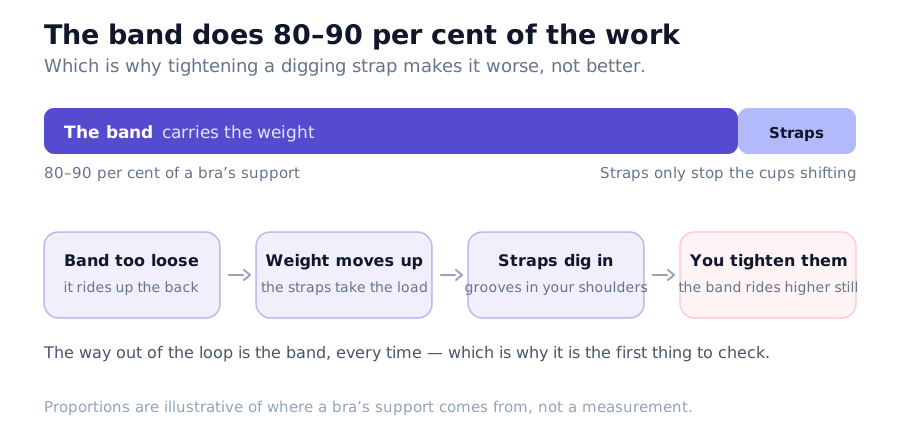
That is why bra fit advice feels contradictory. The symptom and the cause are usually in different places on the garment. Check the band first, then read everything else as a consequence of it.
Before you check anything, put the bra on properly
This step gets skipped constantly, and it invalidates everything after it. A correctly sized bra worn badly fails every check below.
Hook it at the back rather than fastening it at your waist and twisting it round. Twisting stretches the band and bends the wires over time. Then lean forward slightly and scoop: reach into each cup, sweep the tissue from your side and underarm forward into the cup, and settle it. The bra fitting community calls this scoop and swoop, and the difference it makes is not subtle.
Finally, check the wires are sitting where breast becomes chest: in the crease, not below it, and not on top of tissue. If there is skin touching skin underneath the wire, the bra is sitting too low.
Only once all of that is right does it make sense to judge the fit.
How a bra should fit in the back
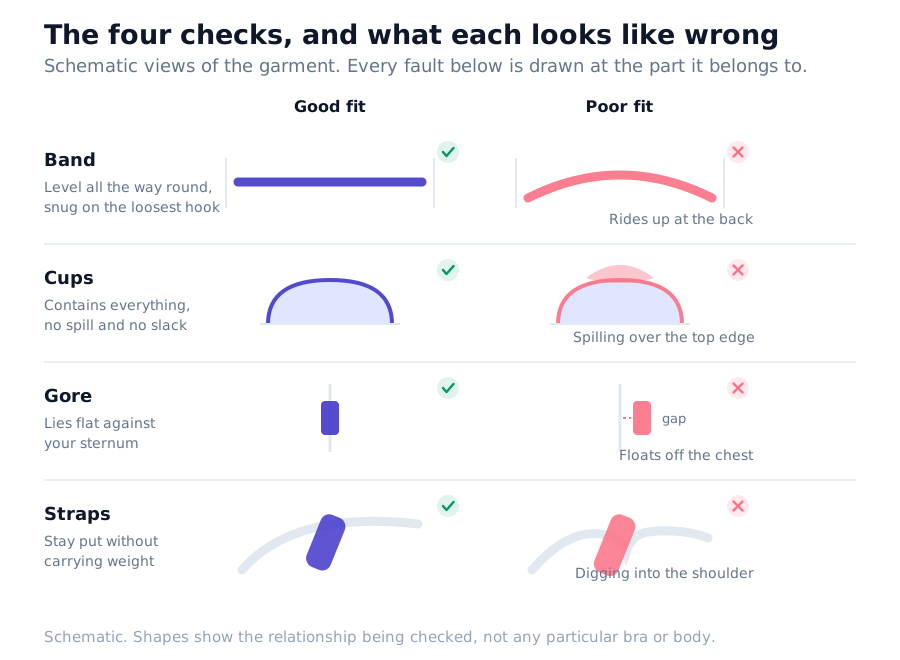
The band should sit level all the way round, the same height at the back as at the front, roughly in line with the bottom of your bust. Not riding up between your shoulder blades.
Fasten a new bra on the loosest hook. The tighter hooks exist because elastic stretches with wear; if you are already on the tightest hook in a bra you just bought, the band is too big and you have nowhere left to go in six months.
The two finger rule is the quick test: you should be able to slide two fingers flat under the band and feel resistance. If your whole hand slips under, it is too loose. If you cannot get two fingers in at all, it is too tight. It is rough rather than precise, but it catches the obvious cases.
Then raise your arms. If the band lifts, it is too big. This is the single most common fit fault there is, and the fix is not simply a smaller band. See sister sizes below.
The trick that tests the band on its own
Here is the problem with everything I just said: cups that are too small pull the band tighter and make it feel like a good fit when it is not. You cannot judge a band while the cups are lying to you.
The fix is a genuinely clever piece of community knowledge. Put the bra on backwards, or upside down, so the cups are not over your breasts at all. Now the band is the only thing being tested. Does it sit level? Is it snug without being painful? That reading is the honest one.
I have not seen this in a single retailer guide, which tells you something about who writes them.
Red marks are not a warning sign
New members of bra fitting communities ask about this constantly, and it sends a lot of people back up into a band that is too big.
A band that is doing its job grips you, and elastic that grips leaves marks, the same way socks and waistbands do. Red marks are only a problem if they are painful, or if they are still there an hour after you take the bra off. Marks alone are not evidence of anything.
How a bra should fit in the front
The centre gore is the panel between the cups. It should lie flat against your sternum, actually touching your chest.
Fitters call this tacking. If the gore floats away from your chest, perches on breast tissue, or you can hook a finger behind it without effort, something is off: usually the cups are too small and tissue is occupying the space the gore needs to sit in.
There are real exceptions, and they matter, because chasing an impossible fit is miserable. If your breasts are very close set, a wide gore will never tack no matter what size you buy, and plunge styles with a low narrow gore are the answer. If you have pectus excavatum, a floating gore may simply be unavoidable. Knowing that a rule does not apply to you is worth as much as the rule.
The opposite complaint, a gore that digs into your sternum rather than resting against it, is often just unfamiliarity, and settles after a few wears. If it does not, a plunge style with a lower gore will usually solve it.
How a bra should fit in the cup
The cups should contain everything, with no overflow and no empty space.
Spilling over the top or the sides means the cup is too small. The version where tissue bulges over the upper edge and creates a second contour is what the fitting community calls quad boob, and it is a cup problem — not, as people often assume, a sign you need a smaller bra.
Wrinkling, gaping or slack fabric usually means the cup is too big. But check two things before you conclude that. Loose straps let the top edge of an otherwise correct cup fall away and gape, so tighten them and look again. And a wrinkling cup can mean the exact opposite of what it appears to, which is worth its own section.
How a bra should fit on the side and under the arm
This is where wire width matters, and almost nobody mentions it.
The underwire should sit on your ribcage, following the natural crease where your breast meets your chest wall, behind the tissue, not on top of it. If the wire pokes into breast tissue at the side, or digs under your arm, it is too narrow for your root width. That is a shape and style problem rather than a size one: going up a cup often will not fix it, but a different cut with a wider wire will.
Tissue escaping toward your underarm is the same story from the other direction: the cup is not wide enough to contain the full base of your breast.
When a bra looks too big and is actually too small
The fitting community calls this orange in a glass, and it is the single most useful piece of vocabulary on this page.
Cup volume and cup footprint are different things. The same volume can sit broad and shallow across the chest, or narrow and projected. If a cup has the right volume but wires too narrow for your root, the tissue cannot settle into it, so the cup wrinkles and gapes and reads as too big, when the actual problem is that it is too small in the dimension that counts.
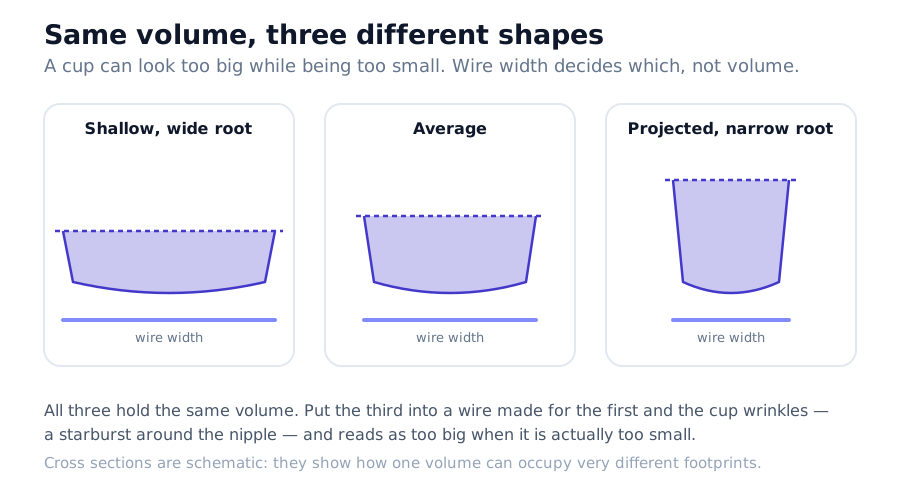
The tell is where the wrinkles are. Slack fabric spread evenly usually means a cup that is genuinely too big. A starburst of wrinkles radiating around the nipple, with the wires resting on tissue rather than behind it, means the opposite: try a narrower wire and a deeper cup, not a smaller one.
When the band feels too tight but the cup is the problem
Here is the mistake I see most often. The bra feels constricting so the obvious move is to go up a band size. Then it rides up your back and you are worse off than when you started.
Cups that are too small make the whole bra feel tight. Breast tissue that cannot fit in the cup gets pushed down and outward into the band and the band pulls harder across your ribs to take up the slack, not what we want ladies. End result? Uncomfortable fit from the band tightness. The reality, the it's just the wrong cup volume.
The band only test above separates the two. If the band feels comfortable with the cups out of the equation, the band was never your problem. Go up a cup size and leave the band alone.
Straps do far less than you think
Straps should stay on your shoulders without carrying weight. You should be able to lift one about half an inch off your skin and no further. One important thing to point out is while straps provide little support they do affect cup fit.
If they slip constantly, the band is usually too loose or the cups are set too wide for your frame. If they leave grooves in your shoulders, they are carrying weight the band should be holding. Either way, the answer is the band.
The exception is anatomical: if you have narrow or sloping shoulders, straps may slide off a bra that fits perfectly everywhere else. That is not a sizing failure, and a racerback clip solves it in about four seconds.
What you notice, and what is actually wrong
| What you notice | What it usually means | What to try |
|---|---|---|
| Band rides up at the back | Band too big | Down a band size, up a cup (a 36C becomes a 34D) |
| Straps dig into your shoulders | Band too loose, so the straps carry the weight | Tighten or size down the band, not the straps |
| Straps slip off | Band too loose, or cups set too wide | Down a band size, or a racerback clip |
| Spilling over the top or sides | Cups too small | Up a cup size, same band |
| Cups wrinkle evenly all over | Cups too big, or straps too loose | Tighten the straps first, then down a cup |
| Starburst wrinkles, wires on tissue | Wires too narrow, orange in a glass | A narrower wire and a deeper cup, not a smaller one |
| Gore floats off your chest | Cups too small, or the wrong style | Up a cup, or a narrower gore |
| Band or gore digs in | Band too small | Up a band size, down a cup |
How a well fitting bra should feel
Almost everything written about bra fit is visual. The question people actually ask is how it is supposed to feel and the honest answer is firmer than you expect.. and probably firmer than anything currently in your top drawer.
If you have been wearing a band that is too big, a correct one feels wrong at first (you're just not use to it yet). Contained rather than restricted is the line I would draw. You should be able to breathe normally and eat a full meal in it. It should not pinch, ache, go numb and you should not be the lady who is secretly trying to adjust it all day. Pressure you notice when you think about it is fine. Pain is where we draw the line!
If the correct band feels like too big of a jump, try a non-stretch band extender for a few weeks for a bridge. Wear the right cup size on a slightly looser band, then drop the extender once your reference point has moved. It beats giving up and going back to a band that does nothing.
The test almost everyone skips: The 1 Hour Test
Every check in this article is a static one. You put the bra on, you look in the mirror and decide. That is also how bras are sold: in a fitting room within 90 seconds of getting fitted.
But bras fail on a longer timescale. A band that sits level standing still can start creeping once you have been moving for an hour. A wire that felt fine begins to press. Straps that seemed right slide down or even worse start to bite. None of that shows up in a mirror when you try it on.
So before you commit to a size.. wear it! Around the house, tags on if you can manage it, for a minimum of 1 hour (bonus if you can do it for the afternoon). Sit down in it, reach above your head, put a coat on. If you work from home try working while wearing it at your desk. If the band has climbed, if you have adjusted the straps more than once or if you are simply aware of it by the end then it is not your size. Even if it looked super cute on you.
Sister sizes, and why “go down a band size” is bad advice on its own
Cup volume is not absolute. A C cup on a 34 band and a C cup on a 36 band hold different amounts, because the letter describes the difference between your ribcage and your bust, not a fixed quantity.
So sizes pair up. A 34D and a 36C hold roughly the same cup volume on different bands. Those are sister sizes.
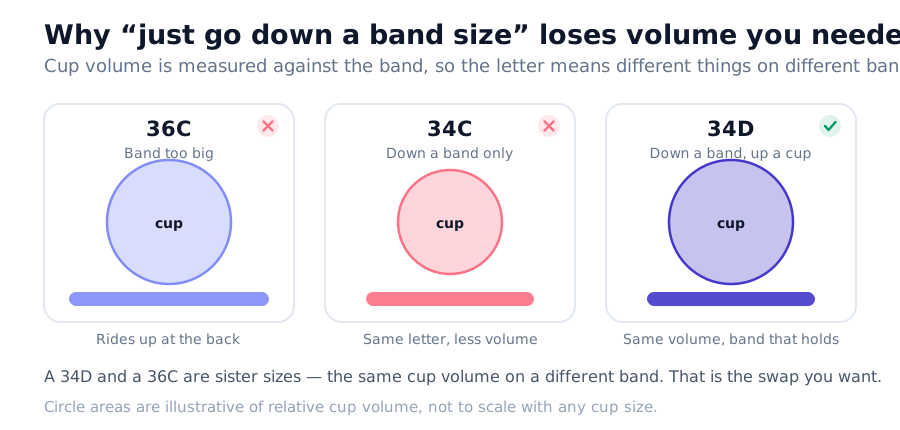
This is why the fix for a riding band is down a band and up a cup, rather than just down a band. Going from a 36C to a 34C fixes the support and removes volume you needed. Going from a 36C to a 34D keeps the volume and moves the support to where it belongs.
It also explains why the number on the label tells you so little on its own, and why a good fitter asks what your bra is doing rather than what it says.
Why the same size fits differently in every brand
A 34F is not a fixed quantity. Bands are elastic and manufacturers cut them to different lengths at different tensions, so two bras with identical labels can sit inches apart on your ribcage. This is why a calculator gives you a starting point rather than an answer, and why "it fit in one shop and not the other" is not you imagining things.
You can measure it directly. Lay the bra flat with a tape measure alongside it, hold one end of the band down, and pull the other until the band is fully extended but before the wires start to twist. That is the band's real stretched length. Compare it across a few bras and the ones that run big become obvious immediately. A band stretching several inches past your under bust measurement will not support you, whatever the label says.
Bratabase is the shortcut. It is a community database of measured bras, and for most mainstream models someone has already recorded the real dimensions.
If your breasts are different sizes
Most people's are, often by enough to matter.
Fit the bra to the larger side: a cup that is slightly roomy is a far smaller problem than one that is too small, which will cut in and distort the fit of everything else. Then tighten the strap on the smaller side to take up the slack. If the difference is still obvious, a removable pad in the smaller cup finishes the job. Stretch lace and unlined styles accommodate a difference better than moulded cups, which hold a fixed shape whether or not it is filled.
How a sports bra should fit
Tighter than an everyday bra, and the band matters more still, because you are asking it to control movement rather than simply hold weight.
The band should feel firm enough that it does not shift when you jump, without restricting your breathing. Cups should be smooth with no spillage. For larger busts, encapsulation styles with separate cups generally control movement better than compression styles that flatten everything against your chest. And test the fit while moving: a sports bra that passes inspection standing still in front of a mirror tells you almost nothing.
How is a strapless bra supposed to fit?
A strapless bra is the clearest possible demonstration of the argument in this article. Take the straps away and the band is doing one hundred percent of the work. Nothing else is holding the girls up.
Which is why a strapless has to be firmer than you would otherwise accept. Most people end up a band size down and a cup size up compared with their usual. If your everyday bra is already borderline on the band, strapless will expose it within minutes.
The failure modes are specific. If it slides down, the band is too loose, not the cups too big. If the top edge gapes when you raise your arms, the cup is too shallow for your shape rather than too large. If it feels secure standing still and migrates the moment you move, that is the band again. Silicone strips and boning help a well-fitting strapless stay put. They cannot rescue one that is the wrong size.
If you have a larger bust
Everything above still applies, and the band matters more rather than less: larger cups put more load on the band, so a loose one fails faster and more painfully.
Two specifics worth knowing. Most high street ranges stop around a DD or an E and then expand the band instead of the cup, which quietly pushes people into bands far too big for them. If your options appear to be a 40C or nothing, you are probably shopping in the wrong range rather than wearing the wrong size. And wire width and cup depth matter more than the letter: a projected shape in a shallow cup will spill regardless of what the label claims.
Fit changes, and so does the bra
A bra that fitted last year may not fit now, and neither of you did anything wrong.
Elastic degrades. With regular wear and washing, most bands lose meaningful support somewhere between six and twelve months. That is the real reason to buy on the loosest hook: you are giving yourself somewhere to go as the band relaxes.
Weight shifts, hormonal cycles and pregnancy all change bust volume, sometimes by a full cup and back again within a month. If a bra fits properly for three weeks out of four, that is not necessarily the wrong size; it may just be the wrong week. Plenty of people keep two sets for exactly this reason.
What you can actually tell from a photo
More than you would expect. Band level, cup edge behaviour, gore position and strap tension are all visible in a straight-on photo, which is what our Does My Bra Fit? tool reads. It names which of the four fit points is off and what to try instead.
What a photo cannot show is which hook you have it fastened on, how the band holds when you move, or how it feels three hours in. So treat any photo-based read as a second opinion rather than a fitting. If you want a starting size to shop with, the Bra Size Guesser suggests a range; if your problem is that no size seems to work, Breast Shape Finder is usually the more useful one, because the cut may be the thing that is wrong rather than the number.
Frequently Asked Questions
Stop wondering — find out now
Bra Size Guesser is free, private, and instant — no account, no public post, no waiting.
Get My ResultMore Bra Fit & Shape Tools
Breast Shape Finder
What bra is best for my breast shape? Upload a photo and our AI names your closest breast shape, then the bra styles that actually suit it.
See your result — freeDoes My Bra Fit?
How do you tell if a bra fits? Upload a photo and our AI reads band, cups, gore and straps one by one, then names the fault and what to try next.
See your result — free