What Is the PSL Scale? (And Why I Stopped Taking It Seriously)
PSL stands for PUAHate, Sluthate and Lookism — three defunct incel forums from the early 2010s. The PSL scale rates a face from roughly 1 to 8 on bone structure, and it claims its authority comes from strict statistical calibration. But its own published percentiles contradict each other: the main rating community's guide puts a PSL 5 at the 30th percentile, while the popular explainer sites describe a 5 as clearly good-looking.
 Written by Brooke Tanner
· August 11, 2026
Written by Brooke Tanner
· August 11, 2026
I went looking for what "PSL rating" actually means expecting to come back and argue with a system. That turned out to be unnecessary. The system argues with itself, in public, in its own documentation, and once you notice it you can't stop noticing it.
Here's the thing that ended the investigation for me. r/Truepslrateme is the main subreddit for getting a PSL rating — people post their faces there and get scored. Its pinned "How to Rate" guide maps the tiers to population percentiles, which is exactly what you'd want a rigorous system to do. Sub-3 is "the bottom 1% of the population." Everything below 5 covers the "1 percentile-30 percentile." Low-low-tier normie runs "30 percentile to the 40 percentile."
Read that second one again. On the scale's own numbers, a PSL 5 sits at roughly the 30th percentile. Below average. Meanwhile the popular explainer sites — the ones ranking for "PSL scale" right now — will tell you a 5 is where you start getting appreciated for your looks, comfortably good-looking, about a 7 in normal money. Both of these are presented as the objective reading of the same number.
Four sources, four different middles
Once I started checking, the disagreement was everywhere. Looksmax.org — one of the forums the thing is named after — says most men land between 3.5 and 4.5. Maxxing.me says the true average is exactly 4. Looksmaxxing Wiki puts the average adult man at 4.5 to 6. And the rating sub's own guide puts a 5 down at the 30th percentile.
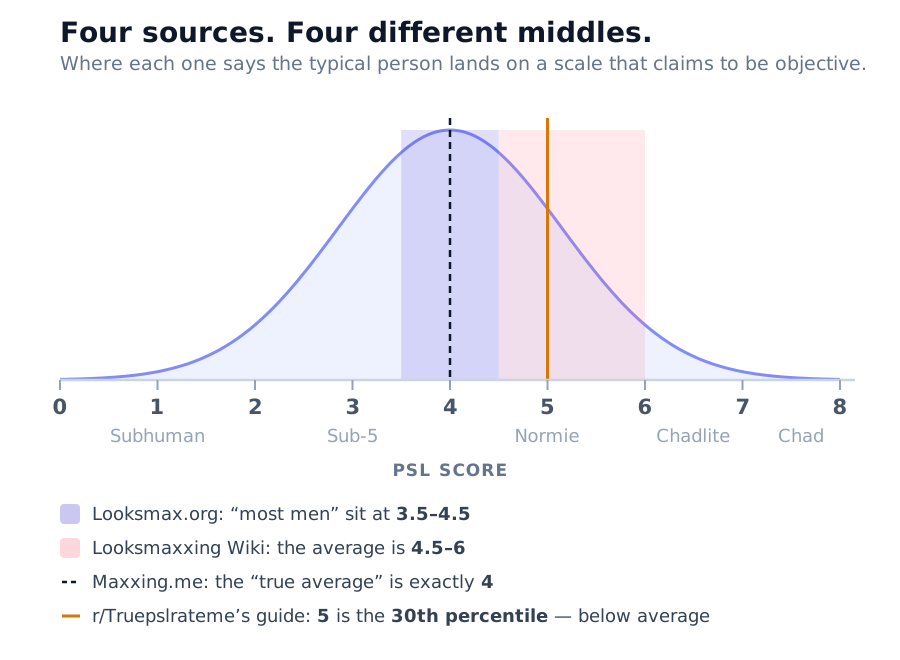
I want to be fair about this: those four aren't answering an identical question. One gives a spread, one gives a point, one averages across age brackets, one gives a percentile. But that's the charitable reading, and even the charitable reading doesn't survive, because they don't merely differ — they contradict. You cannot simultaneously hold that 4 is the true average and that a 5 sits at the 30th percentile. One of those puts the median below 5; the other puts it well above.
The tier percentiles are worse than the average
Keep reading that same rating guide and it gets stranger. High-high-tier normie is "95-99.5 percentile." Chadlite — which starts around 6.5 on an 8-point scale — is "99.5+ percentile," or one person in two hundred. Chad is "practically nonexistent, maybe encompassing .001% of the population," one in a hundred thousand. Over in r/Mewing, a "PSL god" is described as more attractive than "99.9999%+ of the population, or one in several million."
So the top nineteen percent of the scale's range is allocated to the top half of one percent of people, and spans three orders of magnitude of rarity inside that. Meanwhile thirty percent of everyone alive is squashed into everything below a 5.
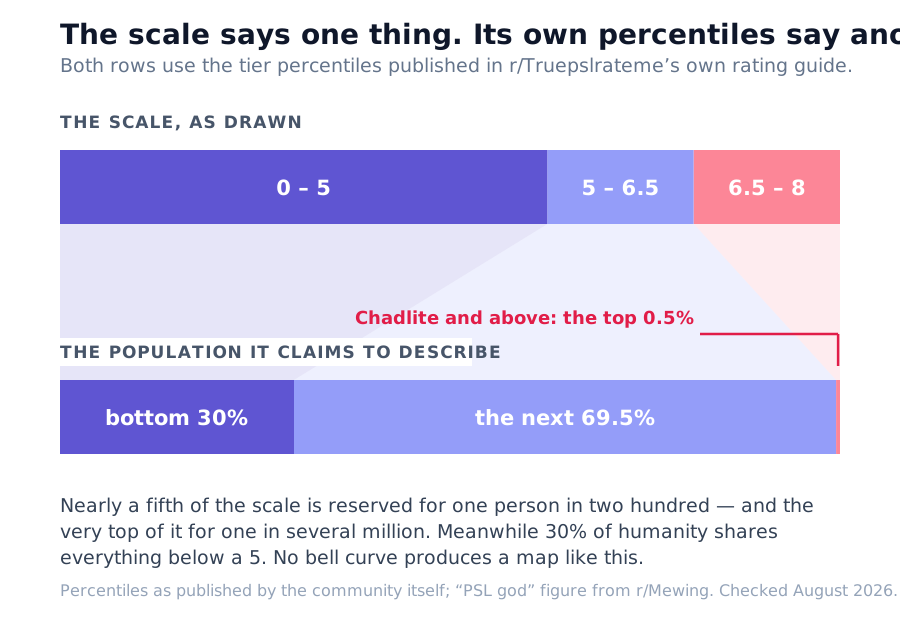
This is not a bell curve. It is not any distribution. It's a system that spends most of its vocabulary describing gradations among people who essentially don't exist, and barely bothers to distinguish between the bottom third of humanity — which tells you precisely what the scale is for, and it isn't measurement.
What the letters actually stand for
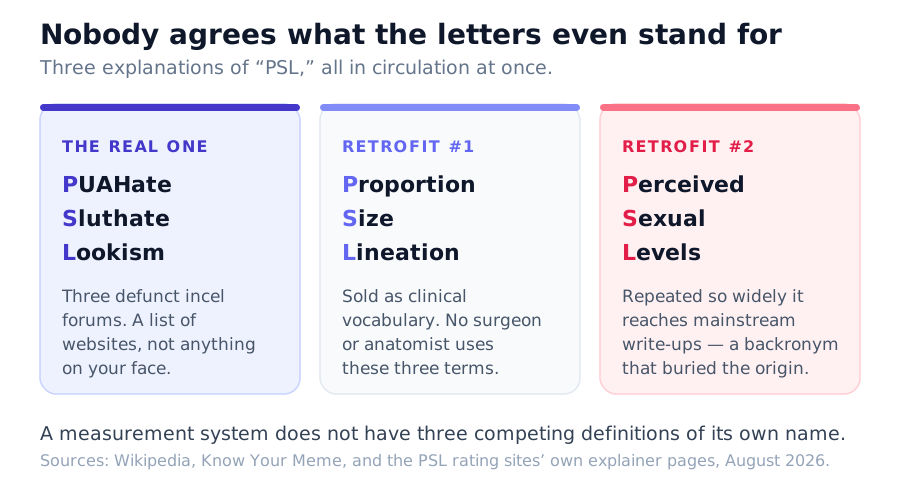
PSL is not an abbreviation for anything on your face. It's a list of three websites: PUAHate, Sluthate, and Lookism — interconnected incel forums from the early 2010s, all long defunct. The rating system was built there for a specific purpose: estimating how women rank men, by men who had concluded that ranking was the only thing that mattered.
That origin has been quietly sanded off as the term went mainstream. Ask a rating site today and you'll be told P is for "Proportion," S for "Size," L for "Lineation" — which sounds like something a maxillofacial surgeon would say and is used by exactly none of them. Elsewhere, including in write-ups that ought to know better, you'll see "Perceived Sexual Levels." Three explanations, all in circulation, all stated flatly as fact.
The same retrofitting happens at the level of individual features. The community talks about your PFL — palpebral fissure length — which is a genuine ophthalmological measurement, and then attaches to it an "ideal" ratio of three-to-one that I can't trace to any clinical source. Real word, invented standard. That's the whole scale in miniature. "Hunter eyes" versus "prey eyes" doesn't even bother with the borrowed vocabulary.
The bell curve is doing public relations
The pitch for PSL is that it's harsh because it's honest. Everyday 1-to-10 ratings are inflated by politeness, the argument goes, so PSL applies a strict curve and strips out the social flattery. Sorry, that's just the data.
But a curve is a description of a population somebody measured, and nobody measured one. There's no sample, no protocol, no published distribution — the curve is asserted, then used as evidence for the numbers placed on it. And you don't need statistics to see it, because a real measurement doesn't move when you drive somewhere. A commenter in one of the ratings communities put it better than I can: he works in a rural town of ten thousand people, and "I'm a straight 10 here. But a normal city I'm like an 8 max. Your rating is 100% effected by availability."
That's someone inside the system, arguing in good faith, describing his own score as a function of who else is standing nearby. Which is the definition of a relative measure, and the opposite of what the scale claims to be.
Even the ratings themselves aren't stable. On the rating sub, one member's assessment: "this subreddit is cooked, all these bots and ppl karma farming. no ones rating accurately anymore."
The tier names tell you what it's for
Follow the scale up from the bottom and the ladder goes subhuman, sub-5, low/mid/high-tier normie, Chadlite, Chad. Writing in The New Yorker in March, Becca Rothfeld put it about as well as it can be put: "A system that designates any person as 'subhuman' is beneath contempt."
This is the part the newer AI scoring sites launder out. "Facial harmony analysis," "canthal tilt assessment," "geometry score" — it reads like a dermatology report. It's a front end for a scale whose bottom rung is subhuman, and that rung isn't a joke the community outgrew. It's the load-bearing idea.
The strongest case for PSL, and why it still fails
I want to give this its best shot, because there is something real underneath. Symmetry, averageness, and sexual dimorphism do show up in published attractiveness research with genuine, replicated correlations. PSL borrows that vocabulary constantly.
What it doesn't borrow is the effect sizes or the caveats. Those correlations are modest and population-level: across thousands of faces, more symmetric ones are rated slightly higher on average. That licenses precisely nothing about your individual face, and certainly not a verdict to the quarter point. The community half-concedes this itself — you'll find members noting that a 0.25 PSL difference is meaningless in real life, and one explaining outright that "psl doesn't mean the same as Attractiveness."
Sit with that one, because it's remarkable. A member of the community will tell you the scale doesn't measure attractiveness. Every AI PSL test on the internet sells it as an attractiveness score.
There's a deeper problem too. The research measures rated attractiveness: what a panel of people said. PSL claims to measure something objective sitting underneath what people say. Those are opposite claims, and the second is borrowing credibility from the first while contradicting it.
And then there's the contradiction at the commercial heart of the whole genre. Looksmaxxing sells ascension — do the routine, climb the scale. But ask the community whether you can actually reach the top and the answer comes back flat: "PSL gods aren't made they're born sorry buddy maybe in the next life."
What it actually costs
I could cite the research here — a 2025 paper by Solea and Sugiura in Crime, Media, Culture argues PSL and looksmaxxing function as a rebrand, incel ideology repackaged as self-improvement, cloaking misogyny and scientific racism in the language of skincare routines. Clinicians at the Child Mind Institute document body dissatisfaction, appearance anxiety, and traits overlapping with body dysmorphic disorder in teenage boys.
But you can just read the threads. Here's a real rating, delivered to a real person who asked for one: "eyes are uneven ... nose is way too big ... jaw is too weak ... no brow ridge." Here's advice someone received about what to do next: "You need double jaw surgery, rhinoplasty, botox, face lift, buccal fat removal ... height surgery where they break your bones and extend the length."
And here's the one I haven't been able to put down. Underneath a post from a kid asking to be scored, someone replied: "You'll look 1000% different when you are 18. ... Dont spend 1 sec thinking about stupid stuff that won't matter in 5 years."
That's a stranger on the internet doing the only humane thing available in that thread, which is telling a child to leave. Somebody had to, because the alternative on offer was a number and a surgical shopping list. The mechanism isn't subtle: give someone a score, tell them it's objective, and put a named tier just above them. The number's job is to make you come back.
What I'd actually do with the question
I'm not going to end on "beauty is subjective, go journal about it." You clicked on this because you want an outside read on how you look, and that's a completely reasonable thing to want.
So get an outside read on the photo. What's working in it, what a different angle or light would change, what someone notices first — those are answerable questions, and the answers are things you can act on. "What number am I, permanently, on a curve nobody sampled, according to a forum that had a word for subhuman" is not a more rigorous version of that question. It's a different question, and it doesn't have an answer.
That's the line our How Attractive Am I? tool is built on, and it's why it deliberately won't give you a score. A number is the part that gets screenshotted, re-run, and checked again next week — which is the business model of every rating site in this space, not a feature they generously included. You'll get a written read on what actually stands out in your photo instead. Less screenshot-able. Considerably more useful.
Frequently Asked Questions
Stop wondering — find out now
Attractiveness Test is free, private, and instant — no account, no public post, no waiting.
Get My ResultMore Body Analysis Tools
Genetic Muscle Potential Calculator
Upload a photo (plus height/weight) and estimate your natural genetic muscle-building potential with AI. Free and instant.
See your result — freeFFMI Calculator
Calculate your Fat-Free Mass Index (FFMI) with an AI-assisted photo estimate plus height and weight. Free and instant.
See your result — freeHow's My Posture?
Upload a side-profile photo and let AI analyze your posture — spine alignment, shoulder position, and forward head posture. Free and instant.
See your result — free